
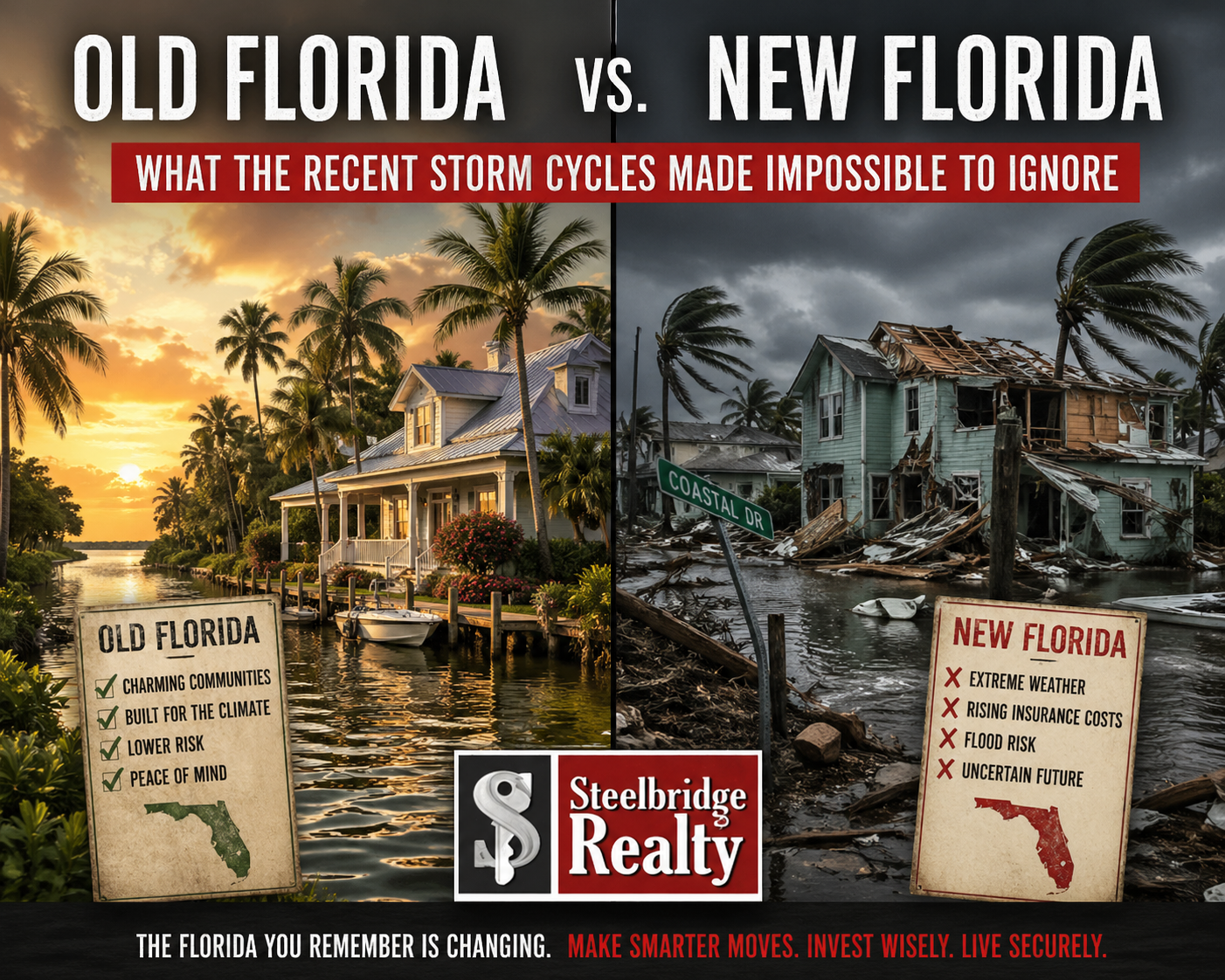
Back-to-back storms in 2024—Hurricane Helene and Hurricane Milton—did more than cause damage. They reinforced a structural shift that had already begun after Hurricane Ian. Taken together, these events exposed a clear divide between what can be called “Old Florida” and “New Florida” construction.
This is no longer theoretical. It is visible in damage patterns, insurance outcomes, and rebuilding requirements across the state.
Storm Surge Became the Deciding Factor
Hurricane Ian was the first major modern test of Florida’s current building standards at scale, particularly along the Southwest Florida coast. It demonstrated that while newer homes performed well against wind, surge remained the primary driver of catastrophic loss.
The 2024 storms—Helene and Milton—confirmed and amplified that lesson.
Storm surge is not just water intrusion. It applies force. It undermines foundations, collapses walls, and destroys everything below the flood line. Across multiple storm events now, the pattern has been consistent. Homes built to modern standards hold together structurally far better. Older homes, especially those built at grade, experience significantly higher loss rates.
Defining the Divide
The line between Old Florida and New Florida aligns with the implementation and evolution of the Florida Building Code.
Old Florida generally refers to homes built prior to the 2002 statewide code adoption that followed Hurricane Andrew. These homes were not designed for current wind loads, nor for modern flood and surge realities. Many lack proper elevation and flood-resistant design.
New Florida refers to construction built under the evolving code, particularly post-Ian refinements and the current 8th Edition with 2024 and 2025 updates. These homes are engineered with both wind and water in mind.
Key differences are structural, not cosmetic.
Elevation is now fundamental. Homes must be built above Base Flood Elevation, often with additional freeboard required by local jurisdictions.
Flood-resistant design is integrated. Breakaway walls, flood vents, and water-resistant materials allow structures to survive inundation without total failure.
Wind resistance has been strengthened through improved connections, impact-rated openings, and updated load calculations.
Hurricane Ian Changed the Baseline
Ian was not just another storm. It reset expectations.
It exposed vulnerabilities in both older housing stock and even some newer homes that were built to earlier versions of the code. It also provided a large dataset for engineers, insurers, and regulators.
Many of the updates seen in the 2025 code cycle trace directly back to Ian’s performance data. Elevation requirements, flood-resistant construction details, and structural load assumptions were all refined based on what failed and what held.
Helene and Milton then validated those adjustments in real time.
The 50 Percent Rule Is Forcing the Transition
One of the most consequential mechanisms in this shift is the substantial damage rule. When damage exceeds 50 percent of a home’s value in a flood zone, rebuilding must comply with current code.
This is accelerating the replacement of Old Florida housing stock. Properties are not being restored to prior condition. They are being rebuilt to New Florida standards.
In practical terms, that often means elevation where none previously existed.
Elevated Construction Is Becoming Standard
The most visible outcome of this shift is the rapid adoption of elevated construction.
Pile and column-supported homes are now the default in many coastal and low-lying areas. Living space is raised above expected surge levels. Lower levels are either open or built with breakaway systems that allow water to pass through.
After Ian, thousands of property owners evaluated or completed home elevations. The 2024 storms accelerated that trend further.
This is changing the physical landscape. Traditional slab-on-grade homes are being replaced with elevated structures that reflect both code requirements and market expectations.
Trade-Offs Are Real
The move to New Florida standards comes with cost.
Elevated construction, deeper foundations, and more complex engineering increase upfront investment. For many long-time property owners, rebuilding to current code is financially challenging.
Neighborhood character is also changing. The aesthetic of elevated homes is different from traditional coastal Florida design.
However, the benefits are measurable.
Modern homes experience lower structural loss rates. Recovery timelines are shorter. In many cases, insurance costs are more manageable relative to risk.
The 2025 Code Updates Reinforce the Direction
The latest updates to the Florida Building Code build directly on lessons from Ian, Helene, and Milton.
Elevation requirements are more precise, particularly in coastal and high-risk flood zones.
Flood-resistant construction standards have been expanded, especially for enclosures and lower-level spaces.
Wind load calculations have been updated using newer engineering standards, increasing structural demands in practice.
The direction is consistent. More elevation. More resilience. Less tolerance for ground-level vulnerability in surge-prone areas.
A Structural Reset Is Underway
What is happening across Florida is not a temporary adjustment. It is a structural reset driven by repeated real-world testing.
Hurricane Ian exposed the weaknesses. The 2024 storms confirmed them. The building code is now adapting accordingly.
Old Florida was built for a different risk profile. New Florida is being built for the current one.
That gap is now embedded in construction costs, insurance underwriting, and buyer behavior. With each storm cycle, the transition accelerates.
Understanding how building codes, elevation, insurance, and storm risk impact a property is no longer optional in this market. It directly affects value, marketability, and long-term risk.
Working with the professionals at Steelbridge Realty LLC means you are not guessing your way through those variables. Whether you are buying or selling, we help you evaluate how a property fits within today’s realities, not yesterday’s assumptions.
If you are considering a move, looking at opportunities, or trying to understand how these changes impact your position, reach out. We will walk you through it with clarity so you can make decisions with confidence.




Views: 29