
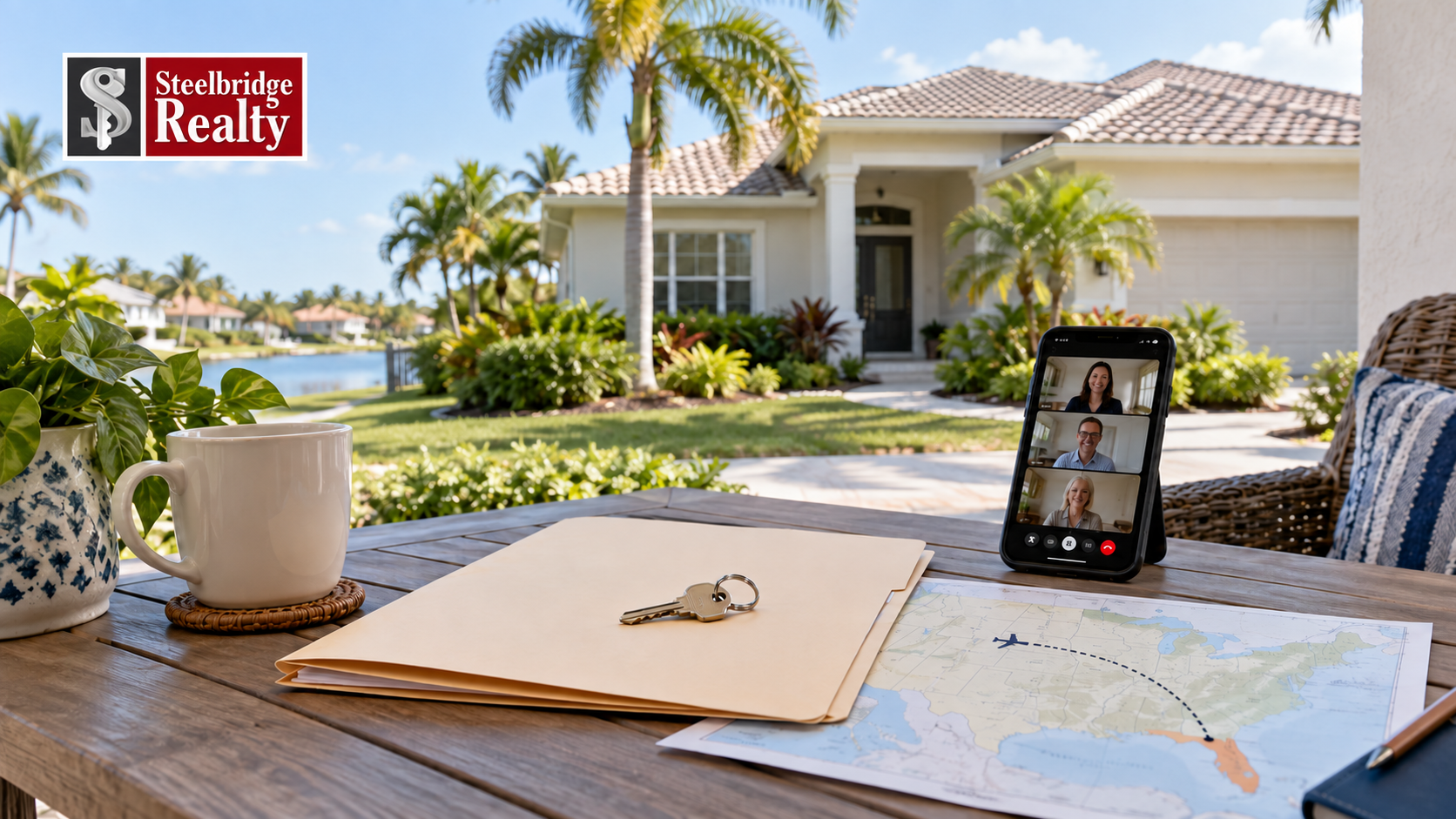
What Happens If You Inherit a House in Florida and Live Out of State?
The Short Answer
If you inherit a house in Florida but live in another state, you can usually keep it, rent it, or sell it without becoming a Florida resident. However, you may need to complete a Florida probate proceeding, secure the property, confirm insurance coverage, resolve outstanding debts or liens, and obtain legal authority before selling or transferring ownership.
Much of the process can be handled remotely with help from a Florida probate attorney, title company, property manager, and local real estate broker.
Do You Have to Live in Florida to Inherit a Florida House?
No. You do not have to live in Florida to inherit Florida real estate.
Your out-of-state residency does not prevent you from receiving ownership of the property. The more important questions are:
- How was the property titled?
- Did the owner have a will or trust?
- Was the property the deceased owner’s Florida homestead?
- Is there a surviving spouse or minor child?
- Does the property have a mortgage, liens, unpaid taxes, or association balances?
- Has someone received legal authority to manage or sell the property?
The answers determine whether probate is required and who has the authority to make decisions.
Does a Florida House Have to Go Through Probate?
It depends on how the property was owned.
Probate may be required when the deceased person owned the house solely in their name. According to The Florida Bar, probate is the court-supervised process used to identify estate assets, pay valid debts and expenses, and distribute the remaining property to beneficiaries.
Probate may not be required when the property passes through another legal arrangement, such as:
- A properly funded revocable living trust
- Joint ownership with rights of survivorship
- Ownership as tenants by the entirety between spouses
- An enhanced life estate deed, commonly called a Lady Bird deed
- Another valid deed or estate-planning arrangement that transfers ownership outside probate
A Florida probate attorney and title company should review the deed, death certificate, will, trust documents, and other estate records before you assume that probate is or is not necessary.
What Is Ancillary Probate in Florida?
Ancillary probate is a Florida court proceeding that may be required when the deceased owner lived in another state but owned real estate in Florida.
For example, if your parent lived in Ohio but owned a winter home in Fort Myers, the main probate case may be opened in Ohio. A separate ancillary proceeding may then be needed in Florida to transfer or sell the Florida property.
Florida Statute 734.102 addresses ancillary administration when a nonresident dies while owning assets in Florida.
If the deceased owner was a Florida resident and you are the out-of-state heir, the estate would generally use the appropriate Florida probate process rather than ancillary probate. Your residence does not determine the type of probate. The deceased owner’s legal residence and the way the property was titled usually matter more.
Can an Out-of-State Heir Serve as the Personal Representative?
Sometimes.
Florida restricts which nonresidents may serve as the personal representative of an estate. Certain close relatives may qualify, including a spouse, parent, child, sibling, aunt, uncle, niece, nephew, and some other relatives identified by law.
Florida Statute 733.304 explains who may qualify as a nonresident personal representative.
Even if you inherit the house, that does not automatically give you authority to sign a listing agreement, hire contractors using estate funds, remove another occupant, or sell the property. That authority may remain with the estate’s court-appointed personal representative until ownership is legally transferred.
Can You Sell an Inherited Florida House While Living Out of State?
Yes. Many inherited Florida homes are listed and sold without the heir traveling to Florida.
Documents can often be reviewed and signed electronically. When original or notarized documents are required, they can generally be handled through overnight delivery, remote online notarization when permitted, or a local notary.
Before closing, the title company will need to confirm:
- Who legally owns the property
- Who has authority to sign
- Whether probate has been completed or the court has authorized the sale
- Whether all heirs or beneficiaries must participate
- Whether a surviving spouse has an interest
- Whether mortgages, judgments, taxes, code enforcement fines, or association balances exist
- Whether the title is insurable
Do not accept an offer based only on the property’s apparent market value. The condition of the house, flood zone, insurance history, open permits, storm damage, roof age, code issues, occupancy, and deferred maintenance can all affect what a buyer will pay.
What Should You Do Immediately After Inheriting the House?
1. Secure the property
Confirm that the doors and windows are locked. Locate all keys, garage remotes, gate devices, and alarm information. If the house is vacant, arrange for someone local to inspect it regularly.
2. Contact the insurance company
Notify the insurer that the owner has died and explain whether the property is occupied or vacant. Do not assume the existing policy will automatically continue unchanged.
Vacancy, deferred maintenance, storm exposure, and ownership changes can affect coverage. Obtain written confirmation of what remains covered and whether a different policy is needed.
3. Keep utilities operating
Electricity, air conditioning, water, lawn care, and pool service may need to continue while the estate is settled. In Florida, turning off the air conditioning can create moisture and mold problems surprisingly quickly.
4. Locate the legal documents
Gather the deed, will, trust, death certificate, mortgage statement, insurance policy, property-tax records, association information, leases, surveys, permits, and repair invoices.
5. Speak with a Florida probate attorney
The attorney can determine whether formal administration, summary administration, ancillary administration, or another procedure applies. Please reach out to us if you need referrals.
6. Order a title and lien review
A title company can identify recorded mortgages, judgments, liens, ownership problems, and other issues that may delay a sale. Please reach out to us if you need referrals.
7. Get a local property evaluation
A Florida real estate broker should inspect the property and compare its likely sale price in its current condition with the potential value after repairs.
What Happens to the Florida Homestead Exemption?
A deceased owner’s homestead exemption does not automatically become the out-of-state heir’s personal homestead exemption.
Florida’s homestead exemption generally applies when an owner makes the property their permanent Florida residence. The Florida Department of Revenue explains that the exemption is not freely transferable from one owner to another.
A change in ownership can also cause the property to be reassessed at or near its current market value for property-tax purposes. This means the future tax bill may be significantly higher than the bill paid by the deceased owner, particularly if the home had been protected by the Save Our Homes assessment limitation for many years.
There can be important exceptions involving surviving spouses and certain dependents. The property appraiser and a Florida attorney should review the particular situation before you estimate future taxes or decide whether to keep the property.
Does Florida Homestead Law Affect Who Inherits the House?
It can.
Florida homestead law provides special protections when the deceased owner is survived by a spouse or minor child. Those protections may restrict how the property can be devised and may create rights that are not obvious from simply reading the will.
An out-of-state heir should not list, transfer, renovate, or distribute the property until a Florida attorney determines whether constitutional homestead protections apply.
Do You Owe Taxes When You Inherit a Florida House?
Florida does not impose a separate state inheritance tax on the recipient of inherited property. However, other tax issues may still apply.
Potential tax considerations include:
- Federal estate-tax issues for larger estates
- Capital-gains tax when the property is sold
- Rental income if the home is leased
- Property-tax reassessment after the ownership change
- Taxes owed by the estate
- Documentary stamp taxes or closing costs associated with a later transfer or sale
Inherited property often receives a new federal income-tax basis tied to its fair market value at the applicable valuation date, frequently the owner’s date of death. This may reduce the taxable gain if the property is sold relatively soon, but the calculation can vary.
Ask a CPA or tax attorney to determine the correct basis before making substantial improvements or selling the property. Keep appraisals, closing statements, repair invoices, and other documentation.
What If Several People Inherit the House?
When multiple heirs inherit a Florida house, decisions can become more complicated.
The heirs must usually agree on whether to:
- Sell the property
- Keep it as a family home
- Rent it
- Repair it before selling
- Sell it in its current condition
- Allow one heir to buy out the others
Disagreements over price, repairs, personal belongings, or access can delay probate and increase carrying costs. If the heirs cannot reach an agreement, litigation or a partition action may eventually become necessary.
A written plan can prevent many disputes. The plan should identify who manages the property, who pays expenses, how reimbursements will be handled, and what happens if one heir wants to keep the home.
Should You Keep, Rent, or Sell the Property?
The best decision depends on the house, the market, and the financial needs of the estate and heirs.
Keeping the house may make sense when:
- You plan to move to Florida
- The carrying costs are manageable
- The property has long-term family or investment value
- The heirs agree on its use
- You can arrange reliable local oversight
Renting the house may make sense when:
- The property is in rentable condition
- Local rent supports the taxes, insurance, maintenance, management, and vacancy costs
- Leasing is permitted by the association and local rules
- The estate or heirs can obtain appropriate insurance
- Someone local can manage repairs and tenant issues
Selling may make sense when:
- No heir plans to use the property
- The home needs substantial repairs
- Insurance, association fees, taxes, or maintenance are becoming burdensome
- Several heirs want their share of the equity
- The property is vacant or difficult to manage remotely
- The estate needs cash to pay debts or expenses
A realistic net-proceeds estimate is more useful than an online home-value estimate. It should account for the property’s condition, expected repairs, closing costs, liens, carrying expenses, and the time required to sell.
Can You Sell the House As Is?
Yes, an inherited Florida house can often be sold in its current condition.
An as-is sale does not eliminate disclosure responsibilities, title requirements, probate requirements, or a buyer’s right to inspect the property. It simply means the seller is generally not agreeing in advance to make repairs.
Selling as is may be practical when the home contains outdated systems, storm damage, mold, an old roof, code violations, abandoned belongings, or years of deferred maintenance. However, a properly marketed as-is property can still attract multiple buyers. “As is” should not automatically mean accepting the first low offer.
Can Steelbridge Realty Handle an Inherited Property Remotely?
Yes. Steelbridge Realty can help out-of-state heirs evaluate and sell inherited property in Southwest Florida without requiring them to manage every detail in person.
Depending on the property and the estate’s legal authority, we can help with:
- An initial property and market evaluation
- Local property inspections
- Photos and condition reporting
- Repair-versus-sell analysis
- Vendor and cleanout coordination
- Pricing and marketing strategy
- Traditional MLS exposure
- As-is sale options
- Communication with the probate attorney and title company
- Electronic documents and remote closing coordination
We are a real estate brokerage, not a law firm or tax advisory firm. When legal, probate, title, or tax questions arise, we work alongside the appropriate licensed professionals.
Frequently Asked Questions
Can I inherit a Florida house if I live in another state?
Yes. Florida residency is not required to inherit Florida real estate.
Do I have to travel to Florida to sell the house?
Usually not. Inspections, listing documents, contract negotiations, title work, and many closings can be handled remotely.
Can I sell the house before probate is finished?
Sometimes, but the estate must have the proper legal authority. The probate attorney and title company should confirm who can sign and whether court approval is required.
Can I remove furniture and personal belongings immediately?
Not necessarily. Personal property may belong to the estate or specific beneficiaries. Confirm your authority before removing, selling, donating, or discarding anything.
What happens if someone is living in the house?
Do not attempt to remove the occupant without legal guidance. The person may be a tenant, beneficiary, surviving spouse, family member, or unauthorized occupant, and each situation can require a different process.
What happens to the mortgage?
The mortgage does not disappear when the owner dies. Payments, insurance, taxes, and association charges may still need to be maintained while the estate determines whether to keep, refinance, or sell the property.
How long does it take to sell an inherited Florida house?
The real estate transaction may take only a few weeks once the property is ready and the seller has authority to close. Probate, title defects, disputes among heirs, liens, missing documents, or repairs can extend the overall timeline.
Who pays the expenses while probate is pending?
The estate may pay authorized expenses when funds are available. If an heir advances money for insurance, utilities, repairs, or maintenance, the payment should be documented and approved by the personal representative and probate attorney.
The Bottom Line
Living outside Florida does not prevent you from inheriting or selling a Florida house. The main challenge is coordinating probate, title, insurance, property condition, carrying costs, and local market decisions from a distance.
The best first step is to confirm who has legal authority over the property. After that, obtain a title review, secure the house, verify insurance coverage, and request an honest local evaluation before deciding whether to keep, rent, repair, or sell it.
For help evaluating an inherited home in Southwest Florida, contact Steelbridge Realty LLC at 239-329-8371 or steelbridgerealtyllc@gmail.com. We can inspect the property, explain the local market, develop a selling strategy, and coordinate with your attorney and title company.
This article is provided for general educational purposes and is not legal, tax, insurance, or financial advice. Probate and homestead issues depend on the specific facts of each estate. Consult qualified Florida professionals before making decisions about inherited property.
Views: 7